OLED Displays

OLED Displays

Active Matrix OLED (AMOLED) Technology: An In-Depth Overview

Active Matrix OLED (AMOLED) Technology: An In-Depth Overview Introduction to Active Matrix OLEDs Active-Matrix Organic Light-Emitting Diode (AMOLED) technology has become a leading display solution across a wide range of devices—including smartphones, smartwatches, televisions, and industrial human-machine interfaces (HMIs). It combines the light-emitting advantages of OLEDs with the precision control offered by an active matrix of thin-film transistors (TFTs), delivering superior image quality, energy efficiency, and design flexibility compared to traditional display technologies like TFT LCDs. How AMOLED Works Combination of OLED and Active Matrix At the heart of AMOLED is OLED (Organic Light-Emitting Diode) technology, which uses organic compounds that emit light in response to an electric current. Unlike passive OLED technologies, AMOLED incorporates an active matrix—a grid of TFTs that allows individual control of each pixel. This active control results in quicker response times, smoother video playback, and highly detailed imagery. Self-Emissive Display AMOLED is a self-emissive technology, meaning each pixel produces its own light. This eliminates the need for a separate backlight, which is required in LCD (Liquid Crystal Display) technologies. The absence of a backlight allows AMOLED panels to be thinner, lighter, and more energy efficient. CLICK HERE FOR SMALL INDUSTRIAL OLEDS CLICK HERE FOR SMALL INDUSTRIAL OLEDS Pixel Control and TFT Layers Each pixel in an AMOLED display is controlled by a small circuit made up of TFTs and capacitors. These components regulate the amount of current that flows through the organic layers to emit the desired brightness and colour. The active-matrix structure ensures that each pixel is refreshed individually, offering superior responsiveness and display uniformity. This precise control over pixels leads to: Faster refresh and response times (ideal for video and gaming) Higher contrast ratios (true blacks where pixels are turned off completely) Improved colour accuracy and stability (essential for professional and industrial uses) Key Advantages of AMOLED Technology Energy Efficiency AMOLED panels are particularly power-efficient because they only consume electricity when pixels are active. Dark areas of an image consume no power as the relevant pixels are completely off. This contrasts with LCDs, where the backlight is always on—either fully or partially, depending on local dimming (e.g., in FALD – Full Array Local Dimming LCDs). The energy savings are especially valuable in battery-powered devices like smartphones and wearables. High Contrast and Colour Reproduction Thanks to its ability to turn individual pixels on and off, AMOLED can produce true blacks and theoretically infinite contrast ratios. The technology supports a broad colour gamut and high dynamic range (HDR), delivering rich, saturated colours and subtle gradations, which are ideal for both entertainment and professional visual applications. Ultra-Thin, Flexible Design Because AMOLED displays do not require a backlight or thick substrates, they can be fabricated on flexible materials. This flexibility has enabled innovative device designs such as: Foldable and rollable smartphones Curved TV screens Wearables with contour-conforming displays Wide Viewing Angles with Consistent Colour AMOLED displays maintain consistent brightness and colour fidelity across wide viewing angles, unlike traditional LCDs which can suffer from colour and contrast shifts when viewed from the side. Challenges and Limitations Burn-in and Image Retention One of the longstanding issues with AMOLED is burn-in, a form of permanent image retention that occurs when static elements (e.g., app icons or navigation bars) remain on screen for extended periods. Over time, these static images can leave ghostly afterimages due to uneven degradation of the organic materials, especially the blue subpixels which degrade fastest. Image retention, a temporary version of this phenomenon, can often be reversed by varying the display content. However, persistent image retention can evolve into permanent burn-in. Material Degradation and Limited Lifespan The organic compounds used in AMOLED degrade over time, reducing brightness and colour accuracy. Blue emitters are particularly susceptible, limiting the overall lifespan of the display. While red and green OLED materials have improved substantially, blue remains a bottleneck for long-term performance. Advancements and Innovations in AMOLED Phosphorescent OLEDs (PHOLEDs) A major development has been the introduction of PHOLEDs, which use phosphorescent materials to improve internal quantum efficiency up to nearly 100%. Compared to traditional fluorescent OLEDs, PHOLEDs require less power and offer a longer lifespan. Currently, PHOLEDs are widely used for red and green subpixels, and the commercial deployment of blue PHOLEDs—expected sometime in 2025—is anticipated to resolve one of the last efficiency challenges in AMOLED technology. Tandem OLED Structures Tandem OLEDs stack multiple light-emitting layers on top of each other, effectively increasing brightness, improving power efficiency, and extending operational life. These are particularly promising for high-end displays, such as professional monitors, automotive dashboards, and ultra-high-definition televisions. Quantum Dot OLED (QD-OLED) QD-OLEDs combine a blue OLED light source with quantum dot materials that convert blue light into red and green. This hybrid approach improves colour accuracy, brightness, and energy efficiency. QD-OLEDs use a similar active matrix of TFTs and are expected to bridge the gap between traditional OLEDs and emerging technologies like micro-LED. CLICK HERE FOR OUR SMALL INDUSTRIAL OLEDS WEBPAGE Future Developments and Research Directions The AMOLED industry is advancing rapidly, driven by both consumer demand and industrial needs. Several next-generation innovations are being explored: TADF (Thermally Activated Delayed Fluorescence): Allows fluorescent materials to achieve higher efficiency by recycling triplet excitons, which could reduce reliance on rare and expensive phosphorescent materials. Hyper fluorescence: A combination of TADF and fluorescence that achieves high efficiency and superior colour purity. Printed OLEDs: Printing OLED layers using inkjet or roll-to-roll processes could drastically lower production costs and enable scalable manufacturing of large, flexible panels for signage, automotive, and architectural applications. Summary AMOLED represents a highly advanced display technology that brings together high contrast, vivid colour reproduction, mechanical flexibility, and excellent power efficiency. While challenges such as material degradation and image burn-in persist, ongoing research and development are rapidly addressing these limitations. With innovations like PHOLEDs, tandem layers, and quantum dots, AMOLED is poised to remain a dominant display solution across both consumer electronics and industrial sectors for years to come. Check Out Some Of Our Displays in Action https://www.youtube.com/watch?v=BnCu07hOmH4https://www.youtube.com/watch?v=bBSnHwbbKeo&t=7s Need More Information?
OLED Displays

CDSs 1.5 Inch Full Colour Square OLED Display

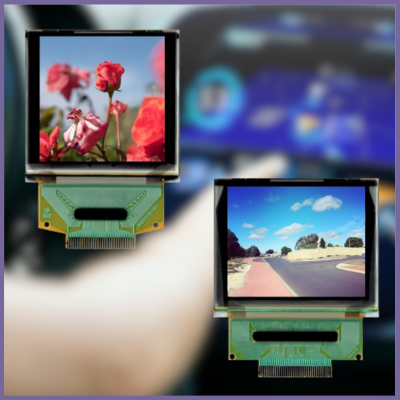
CDS’s 1.5 inch Full Colour Square OLED Display Introduction to our Full Colour Square OLED Display Experience cutting-edge display technology with the newly launched 1.5-inch Full Colour Square OLED Display by CDS. Designed to meet the demands of industrial, auto/aero, and military applications, this OLED display offers unparalleled performance and versatility. In this blog post, we’ll delve into the key features and benefits that make this 1.5-inch square OLED a game-changer in the world of display solutions. Compact and Robust Design Measuring a mere 33.8(H) x 34.0(V) x 1.6(D)mm, CDS’s 1.5-inch OLED display is both thin and lightweight, making it an ideal choice for applications where space is a premium. With an active area of 26.8(H) x 26.8(V)mm and weighing just 4.5g, this display seamlessly combines compactness with robustness, ensuring durability in diverse environments. Extreme Temperature Endurance Operating in temperatures ranging from -40°C to +85°C, this OLED display thrives in challenging conditions. Whether it’s the heat of industrial settings or the frigidity of military environments, the 1.5-inch square OLED by CDS stands resilient, offering reliability where other displays might falter. Optical Brilliance Boasting an impressive optical performance, this OLED display provides nearly 180° viewing angles on all axes. The super-fast response time of less than 10µs contributes to the creation of striking, animated graphics and full-color video content. The 10,000:1 contrast ratio ensures crisp images, while the display’s inherent excellence in both darkness and full sunlight makes it versatile for indoor and outdoor applications alike. Flexibility in Interface Options Developers enjoy flexibility with the 1.5-inch square OLED, as they can choose between 3/4 wire SPI or parallel interface options. This adaptability ensures seamless integration into various projects, allowing for a customized user experience based on specific requirements. Click here for our full range of square LCD panels Conclusion In conclusion, CDS’s 1.5-inch Full Colour Square OLED Display sets a new standard in display technology. From its compact and robust design to its exceptional optical performance and flexibility in interface options, this OLED display is a powerhouse for a myriad of applications. Elevate your visual experience and unlock the possibilities of vibrant, animated graphics and video content with the unmatched capabilities of CDS’s 1.5-inch square OLED display. Check Out Some Of Our Displays in Action Need More Information? CALL US +44 (0)1634 791600 CLICK TO EMAIL US!

OLED Displays

CDS Launches 27 inch 4K AMOLED Display for Industrial Projects

CDS Launches 27 inch 4K AMOLED Display for Medical Projects medical-grade AMOLED for the most demanding of applications In industries where precision and clarity are non-negotiable, display technology must rise to the challenge. That’s why CDS introduces its latest 27.0-inch 4K medical-grade AMOLED display, engineered for superior performance in demanding applications. Our latest advanced LTPS AMOLED module is designed to meet the demanding requirements of industrial and medical applications. With its ultra-high resolution of 3840×2160 pixels and an impressive contrast ratio of 100000:1, this industrial display ensures highly detailed and vibrant visuals, making it an ideal solution for applications requiring precision, such as medical diagnostics, industrial control systems, and professional content creation. Key Features and Specifications: Superior Display Performance: The AMOLED technology provides deep blacks and enhanced contrast, delivering lifelike image quality that is crucial for industries where accuracy is paramount. Ultra-High Resolution: With a 3840×2160 (4K UHD) resolution, the medical-grade AMOLED guarantees sharp and crystal-clear visuals, making it ideal for high-end applications. Vivid and True-to-Life Colours: Supporting 1.07 billion colours (RGB 10bit) and 100% colour gamut, this display offers an extensive colour spectrum, ensuring superior colour accuracy and consistency. Optimal Visibility in Bright Environments: With a luminance of 400 cd/m², the screen remains clear and readable even in well-lit conditions. Lightning-Fast Response Time: A rapid 1ms response time ensures smooth transitions and eliminates motion blur, making it suitable for high-speed applications. Wide Viewing Angles: With a free viewing angle and minimum viewing angles of 85°/85°/85°/85°, the display maintains consistent colour and clarity from various perspectives. Advanced LTPS Technology: Low-temperature polycrystalline silicon (LTPS) technology enables precise pixel control and energy-efficient operation, making it a long-lasting and reliable solution. High-Speed Interface: The EDP (with an optional HDMI interface) ensures fast data transmission and seamless display performance. Robust and Versatile Design: With overall dimensions of 607.66mm (H) x 348.18mm (V) x 1.24mm (D) and an active display area of 597.66mm (H) x 336.18mm (V), it is a compact yet powerful display solution. Durability and Longevity: Designed for professional use, the 4K UHD display has an impressive lifetime of 25,000 hours and can operate within a temperature range of -20℃ to +70℃, making it suitable for various environments. Power Requirements: The module operates at an input voltage of 24V, ensuring compatibility with industrial power systems. Reliable Storage and Operation: With a storage temperature range of -40℃ to +85℃, the display maintains stability under varying conditions. Click here for our Industrial OLEDs Setting a New Standard in Display Technology The 27.0-inch medical-grade AMOLED display from CDS is engineered to set new benchmarks in display performance, offering unparalleled clarity, colour accuracy, and efficiency. Whether used in medical imaging, industrial automation, broadcasting, or design applications, this display ensures professionals have access to the highest level of visual fidelity. For those seeking an advanced display solution with exceptional performance, reliability, and cutting-edge technology, the 27.0” 4K AMOLED module stands as the ideal choice. Product Overview: Product Description: 27.0-inch 4K UHD AMOLED Display Display Type: AMOLED Resolution: 3840 x 2160 pixels Pixel Pitch: 0.15564(H) x 0.15564(V) mm Colour Support: RGB 10bit (1.07 billion colours) Colour Gamut: 100% Response Time: 1ms Contrast Ratio: 100000:1 Luminance: 400 cd/m² Viewing Angles: 85°/85°/85°/85° Interface Type: EDP (HDMI option available) Input Voltage: 24V Lifetime: 25,000 hours Operating Temperature: -20℃ to +70℃ Storage Temperature: -40℃ to +85℃ With its state-of-the-art technology, high resolution, and exceptional performance, this display is set to revolutionise professional visual applications, delivering unmatched clarity and precision for critical tasks. 📢 Interested in integrating this next-generation AMOLED display into your application? Contact us today for more details and customisation options. Click here to find out more about our AMOLEDs Conclusion Crystal Display Systems’ 27.0-inch 4K medical-grade AMOLED display redefines professional-grade visual solutions, combining cutting-edge LTPS AMOLED technology with ultra-high resolution, exceptional contrast, and vibrant colour accuracy. Designed to meet the stringent demands of industrial, medical, and professional applications, this display ensures precise image rendering, durability, and long-term reliability. Whether for medical imaging, industrial control systems, high-end content creation, or broadcasting, this module provides an unparalleled viewing experience with superior clarity, fast response times, and robust performance in diverse environments. With its advanced technology and long lifespan, the CDS 27.0” AMOLED display is the ultimate solution for professionals seeking next generation display excellence. Check Out Some Of Our Displays in Action https://www.youtube.com/watch?v=9al14BPKWwghttps://www.youtube.com/watch?v=BDFd4qQKF0U Need More Information? CALL US +44 (0)1634 791600 CLICK TO EMAIL US!

amoled displays
OLED Displays

The Automotive Industry and Touchscreen OLEDs are the Future

The Automotive Industry and Touchscreen OLEDs are the Future The Rise of OLED Display Technology in Automobiles Displays in the automotive industry are increasing in importance, the size and number of displays are now key indicators of a vehicle’s technological content and innovation, influencing buyers’ perceptions much like horsepower once did. Whether the engine is internal combustion, hybrid, or electric, the display size significantly impacts the perceived capabilities of the vehicle. Automakers are increasingly prioritizing advanced human-machine interface (HMI) displays to make a strong first impression, and Organic Light Emitting Diode (OLED) technology is playing a crucial role in this regard. OLED displays not only enhance initial impressions but also offer substantial benefits to both users and cockpit designers. Click here for our Flexible OLEDs BLog Post Growth of the Automotive Display Market A report by the Korea Display Industry Association (KDIA) predicts that the global automotive display market will grow at an average annual rate of 7.8%, from $8.86 billion in 2022 to approximately $12.63 billion by 2027. The adoption of OLED displays is a significant driver of this growth. Although OLEDs accounted for only 2.8% of the market share in 2022, this is expected to rise to 17.2% by 2027. Advantages of OLED Technology OLED technology offers several advantages over traditional liquid crystal display (LCD) technology, which has been the mainstay in automotive displays. The high-quality visuals and thin form factor of OLEDs, already popular in consumer electronics, are now being embraced by the automotive industry for both aesthetic and functional reasons. True Black and High Contrast: OLEDs are emissive displays, meaning that when a pixel is off, it emits no light, achieving true black. This is in contrast to LCDs, which block light from a backlight unit, resulting in dark grey instead of true black. OLEDs provide higher contrast and avoid issues like blooming or haloing seen in LCDs with local dimming. Click here for our OLED displays Benefits for Automotive Users Enhanced Comfort: Most in-car graphical user interfaces (GUIs) use black backgrounds to reduce driver distraction at night. OLED’s true black enhances user comfort. Improved Safety: High contrast improves display readability, contributing to overall vehicle safety. Wide Viewing Angles: Ensures displays are visible from various positions within the vehicle. Fast Response at Low Temperatures: OLEDs maintain fast response times even in cold conditions, ensuring critical information is visible without delay. Eye-Friendly: OLEDs reduce eye fatigue by not requiring backlighting, which is beneficial for long-duration use. Cockpit Design and Efficiency OLED technology aids automakers in overcoming several design challenges: Lighter and Thinner: OLEDs offer fewer layers and a thinner structure, making large screens lighter and reducing vehicle weight. Innovative Designs: Allows for smaller radius curved designs, enabling unique cockpit layouts. Seamless Integration: The true black technology allows the display bezel to blend into the black trim, providing a sleek look. Lower Power Consumption: Particularly beneficial for electric vehicles, OLEDs consume less power, extending battery life. Click here for OLED displays Advances in OLED Technology Concerns about OLED technology, such as burn-in effects and brightness issues, have been addressed with advancements like the two-stack OLED or Tandem OLED structure, which increases brightness and disperses energy for higher stability and longer lifespan. These improvements have led to increased adoption of OLED displays in high-end vehicles. The Importance of Touch Interface A reliable touch interface is critical for user experience, especially in vehicles where conditions can vary widely. Automotive touchscreens must support gloved-finger operation, be electromagnetically compliant, and meet safety standards like ISO26262 ASIL-B. OLED technology uses on-cell touch designs, which, while thinner and lighter, present challenges such as higher capacitive load to the ground. Effective touch controllers must address these challenges with high signal-to-noise ratio (SNR) sensing, powerful noise cancellation, and efficient signal processing. Click here to check out our range of 4K AMOLEDs Conclusion OLED technology offers significant advantages in automotive display applications, providing high-quality visuals, energy efficiency, and innovative design possibilities that enhance both aesthetics and functionality. As Crystal Display Systems Limited continues to integrate advanced display solutions, the adoption of OLED displays is set to transform the automotive industry, meeting the evolving demands of modern consumers, and positively influencing purchasing decisions. Check Out Some Of Our Displays in Action https://www.youtube.com/watch?v=L0p9FGdFavMhttps://www.youtube.com/watch?v=BnCu07hOmH4 Need More Information? CALL US +44 (0)1634 791600 CLICK TO EMAIL US!

OLED Displays

How do Flexible AMOLED Displays Work?

How do Flexible AMOLED Displays Work? Bend, Fold, and Roll with CDS Flexible AMOLED Displays Flexible AMOLED is an advanced display technology derived from AMOLED. It replaces traditional rigid glass substrates with flexible materials, such as polyimide films enabling displays that can bend, fold and even roll.  It inherits the core benefits of AMOLED, such as high contrast, vivid colours and self-emissive pixels, while offering the additional mechanical flexibility and durability. This Optically Superior 8.01” Flexible AMOLED display represents the pinnacle of modern display technology, catering to industries that demand exceptional visual fidelity, flexibility, and durability. Key Features of our 8.01” Flexible AMOLEDs: Display Type: Flexible AMOLED: Allows for curved or foldable designs, suitable for modern smartphones, tablets, or other innovative devices. Incell CTP: Capacitive Touch Panel integrated directly into the display, enabling thinner and more responsive screens. Resolution & Visual Quality: Resolution: 2840 x 1860 pixels, delivering a high pixel density and sharp image quality. Brightness: 600 nits, ensuring good visibility even under bright lighting. Colour Depth: 16.7 million colours for vibrant, true-to-life visuals. Colour Gamut: 99% coverage ensures accurate colour reproduction, excellent for professional and creative use. Contrast Ratio: 400,000:1, providing deep blacks and bright whites for exceptional clarity and detail. Interface: MIPI Interface: A standard high-speed interface widely used in display technology for efficient data transfer. Physical Dimensions: Outline Dimensions: 165.69mm (H) x 137.92mm (V) x 0.34mm (D), signifying an ultra-thin and compact design. Active Area: 162.69mm (H) x 122.02mm (V), nearly borderless for an immersive viewing experience. Operational Durability: Temperature Range: Operates effectively from -40°C to +80°C, making it suitable for harsh environmental conditions. Applications for our 8.01” Flexible AMOLEDs: Foldable or rollable devices High-end smartphones and tablets Automotive displays Wearable tech and other innovative uses This display is well-suited for applications demanding flexibility, premium image quality, and robustness. Click here to discover our Industrial OLEDs page Conclusion In conclusion, the 8.01” Flexible AMOLED display stands at the forefront of next-generation display technology, combining cutting-edge flexibility with superior visual performance. Its high resolution, vibrant colour accuracy, and robust durability make it an ideal solution for industries seeking innovative and high-quality display solutions. Whether for foldable smartphones, automotive interfaces, or wearable tech, this display redefines what’s possible in modern screen technology, paving the way for more dynamic and immersive user experiences. Check Out Some Of Our Displays in Action https://www.youtube.com/watch?v=9al14BPKWwghttps://www.youtube.com/watch?v=BDFd4qQKF0U&t Need More Information? CALL US +44 (0)1634 791600 CLICK TO EMAIL US!

OLED Displays

4K AMOLED Displays: Revolutionizing Visual Technology

4K AMOLED Displays: Revolutionizing Visual Technology 4K cutting-edge display technology In the world of cutting-edge display technology, 4K AMOLED screens stand out as a pinnacle of innovation and quality. AMOLED, short for Active Matrix Organic Light-Emitting Diode, is a technology that enhances visual experiences with unparalleled color accuracy, deeper blacks, and vibrant brightness. When combined with 4K resolution (3840 x 2160 pixels), these displays deliver exceptional clarity. What Sets AMOLED Apart? AMOLED panels use organic compounds that emit light when an electric current passes through them. This eliminates the need for a backlight, as each pixel is self-emissive, enabling finer control over brightness and colour. This technology leads to superior contrast ratios, enabling true blacks and vibrant, lifelike colours. Additionally, AMOLED displays are thinner and more flexible than their TFT LCD counterparts, making them an excellent choice for foldable and curved screen designs. Enquire Now AMOLED vs TFT LCD: Key Advantages 1. Contrast and Colour Reproduction One of the most significant advantages of AMOLED displays over traditional TFT LCDs (Thin-Film Transistor Liquid Crystal Displays) is their ability to produce true blacks. In AMOLED panels, individual pixels turn off completely to display black, resulting in infinite contrast ratios. In contrast, TFT LCDs rely on backlighting, which often causes light leakage and makes blacks appear greyish. 2. Power Efficiency While AMOLED screens can consume more power when displaying bright, white content, they are generally more power-efficient for darker themes and displays with a high black-to-color ratio. TFT LCDs, on the other hand, require a constant backlight, consuming more energy across the board. 3. Design Versatility AMOLED panels are more versatile in terms of design. Their flexibility allows for innovative applications like foldable smartphones and edge-to-edge displays. TFT LCDs, being rigid, do not offer this flexibility. High-End UHD OLED Displays For years, we have been dedicated to delivering high-end LCD displays featuring ultra-high brightness, wide color gamut, and exceptional contrast ratios. Building on this foundation, we are proud to introduce our UHD OLED displays, available in sizes ranging from 13″ to 27″. These panels offer a stunning 4K resolution of 3840 x 2160, an eDP interface, and reliable performance in industrial environments with operating temperatures between -20°C and +70°C. OLED technology offers clear advantages over traditional TFT LCDs. OLED displays are thinner, lighter, and consume less power, making them ideal for applications demanding efficiency and portability. The true blacks, vivid colors, and significantly higher contrast ratios of OLED panels are immediately noticeable, providing a superior visual experience compared to LCDs. The market reflects this shift toward OLED technology. According to a recent market research report, the AMOLED display market is projected to grow at an impressive compound annual growth rate (CAGR) of 25% from 2023 to 2027. In contrast, the TFT LCD market is expected to grow at a more modest CAGR of 4.75% during the same period. As OLED adoption accelerates, these displays are becoming a preferred choice across a wide range of industries. Beyond their established presence in smartphones and tablets, OLED panels are increasingly being utilized in applications such as in-flight entertainment systems, automotive displays, medical equipment, and more. Download Our Small Medium Displays Brochure Conclusion As demand for high-quality visuals grows, 4K AMOLED technology is poised to dominate in various sectors, including entertainment, gaming, and productivity. With advancements in durability and power efficiency, AMOLED displays are setting new standards for display excellence, shaping the future of consumer electronics. Whether it’s for streaming videos, gaming, or professional editing, 4K AMOLED screens are redefining how we see the digital world. Check Out Some Of Our Displays in Action https://www.youtube.com/watch?v=L0p9FGdFavMhttps://www.youtube.com/watch?v=BDFd4qQKF0U Need More Information? CALL US +44 (0)1634 791600 CLICK TO EMAIL US!

OLED Displays

KD024EGOIN144 2.4″ AMOLED Display: A Compact Powerhouse for Portable Devices

KD024EGOIN144 2.4″ AMOLED Display: A Compact Powerhouse for Portable Devices high-performance 2.4″ AMOLED designed for hand-held and portable devices Crystal Display Systems (CDS) continues to push boundaries in display technology, and the KD024EGOIN144 2.4 inch AMOLED display module is no exception. This display brings a suite of high-performance features designed for hand-held and portable devices. Let’s take a closer look at what makes this module stand out. Key Features of the 2.4 inch AMOLED High Resolution (450×600 dots) The 2.4 inch AMOLED KD024EGOIN144 boasts a high-resolution display, ensuring sharp, detailed images. This makes it an ideal choice for devices that require clear visual output, such as medical devices and handheld instrumentation. Advanced Driver IC (RM690B0)    Equipped with the RM690B0 driver IC, this module supports multiple interfaces, including SPI, MCU, and MIPI. This flexibility allows for easier integration into various devices, offering compatibility and convenience for developers working across different platforms. Impressive Brightness and Contrast    – Brightness: With a brightness level of 800 cd/m², this display excels in a variety of lighting conditions, including bright outdoor environments.    – Contrast Ratio: The module’s incredible 1,000,000:1 contrast ratio ensures deep blacks and vivid colours, delivering an immersive viewing experience. Key Features Part 2 Wide Operating Temperature (-20°C to +80°C) Whether in freezing cold or scorching heat, the KD024EGOIN144 is built to perform. Its wide temperature range makes it suitable for both consumer and industrial applications, including outdoor environments where weather conditions can be extreme. Compact and Durable Design The compact size of the 2.4 inch AMOLED is perfect for portable, space-conscious devices, while its rugged build ensures long-lasting durability. This combination of size and strength makes it well-suited for demanding applications. Applications: – Hand-held instrumentation – Portable medical devices – Wearables – Industrial handheld controllers Click here for our full small format industrial OLED range Conclusion The 2.4 inch AMOLED KD024EGOIN144 is more than just a display module; it’s a powerhouse of performance, versatility, and durability. By blending high-resolution visuals with a robust design and wide compatibility, this AMOLED module sets a new benchmark for display technology, catering to both the consumer and industrial sectors. Whether for medical wearables or industrial controllers, it offers unmatched quality and reliability for next-gen portable devices. Check Out Some Of Our Displays in Action https://www.youtube.com/watch?v=lyHka-C-nRchttps://www.youtube.com/watch?v=i5mviKJk-a0 Need More Information? CALL US +44 (0)1634 791600 CLICK TO EMAIL US!

OLED Displays

Transparent PMOLED Displays: Revolutionising Small OLEDs

Transparent PMOLED Displays: Revolutionising Small Display Technology Innovative Transparent PMOLED Displays could enhance your project Once again, CDS and our display partners are at the cutting edge of display technology, introducing a groundbreaking development in small display components: transparent PMOLED displays. These innovative modules are transforming the landscape of display technology, offering an unparalleled combination of performance, aesthetics, and functionality. At the forefront of this advancement is our 1.51” diagonal module, part number UG-2856KLBAG01, which showcases the extraordinary potential of transparent PMOLED technology. Key Features High Transparency High Contrast Ratio Viewing Angle: 360 Fully transparent Fast Response Time (≤10μs) Thinner & Lighter & Durable No need of backlight, self-emitting Wide Temperature Range (-40°C~85°C) Apply to most products from any area. Trend of Displays Leading the green vision 1.51″ Diagonal Size   128 x 56 pixels Light Blue Colour Depth         Pixel Pitch (mm) 0.274 x 0.274 ( 93 PPI ) SPI, I2C Transparency Typ. 50% @ Wavelength 550nm RoHS Compliant Halogen Free REACH Certificate Compact and Clear The UG-2856KLBAG01 transparent PMOLED display is an incredibly compact module, measuring just 42.04(H) x 27.22(V) x 1.25(D)mm. Despite its small size, this module delivers an impressive 128 x 56 pixels within an active area of 35.05(H) x 15.32(V)mm, ensuring crisp and clear visuals. This compact design makes it ideal for applications where space is at a premium, without compromising on display quality. Modern Blue Light One of the standout features of this module is its monochrome light blue display, which offers a modern and contemporary aesthetic, distinguishing it from the more traditional yellow displays typically seen in PMOLED technology. Beyond its visual appeal, the display boasts a fast response time of ≤10µs, ensuring smooth and flicker-free operation even in dynamic environments. Optically an Excellent Choice The transparent PMOLED display also excels in optical performance, offering 180° viewing angles, 120cd/m² brightness, and an ultra-high contrast ratio of 10,000:1. Its transparency, ranging between 50% and 60%, allows users to view through the unlit pixels, making it an excellent choice for applications where visibility and transparency are essential. Flexible Communication To enhance integration and communication flexibility, the UG-2856KLBAG01 is equipped with the industry-standard Solomon Systech SSD1309 controller IC. This controller provides a range of interface options, including 8-Bit Parallel, 4-Wire SPI, and I²C, making it easier for designers to incorporate the display into various systems. Click here for our Small Format OLED Displays Conclusion Transparent PMOLED displays represent a significant leap forward in display technology, combining compact design, modern aesthetics, and outstanding optical performance. The UG-2856KLBAG01 module from CDS showcases these attributes perfectly, offering a solution that meets the demands of cutting-edge applications. As transparent PMOLED displays continue to evolve, they are set to redefine the possibilities of small display technology, reinforcing CDS’s position as a leader in innovative display solutions. Check Out Some Of Our Displays in Action https://www.youtube.com/watch?v=L0p9FGdFavMhttps://www.youtube.com/watch?v=g9Gf5y_kEf8&t=60s Need More Information? CALL US +44 (0)1634 791600 CLICK TO EMAIL US!

OLED Displays

Discover our Small Format Graphic OLED Displays

Discover our Small Format Graphic OLED Displays Discover our KD017PWIOL003, 1.71” and KD022PWSOL037, 2.23” 128×32 Graphic OLED Displays Finding the perfect balance between performance, versatility, and compact design is crucial for today’s OEM products. Introducing our latest offerings: the KD017PWIOL003 and KD022PWSOL037 OLED graphic displays. These 1.71″ and 2.23″ modules are designed to bring the cutting-edge potential of OLED technology to a wide range of applications. With sharp graphics, enhanced visibility, and robust reliability, these displays are the ideal solution for meeting the diverse demands of modern electronic designs. Unleash the potential of OLED technology with these dynamic, compact yet powerful graphic display modules designed to meet the diverse application needs of today’s OEM products. Compact and Powerful Both the 1.71” and 2.23” OLED screes feature a 128 x 32 dot resolution, which delivers sharp graphics in a compact design. Their 55.02 x 13.10 and 42.22 x 10.54 active areas make them ideal for space-constrained applications. Versatile Interface Options Equipped with a built-in industry standard Solomon Systech SSD1305 & SSD1312 drivers the modules support SPI and I2C interfaces on the 2.23” and I2C on the 1.71”, ensuring ease of interfacing and integration into various electronic designs without compromising performance. Enhanced Visibility and Contrast The modules feature the on-trend white colour and deliver a 120nit brightness with high contrast ratios of up to 2000:1, near on 180° degree viewing angles and a free viewing direction ensures excellent visibility at all angles in all lighting conditions both indoors and outdoors. Simple Integration A single 3.3V power supply simplifies your power circuit design, plus with the modules COB PCB design, mounting within your application is via for screw holes, reducing the need for a customised display carrier often associated with the integration of COG versions. Reliability in Harsh Environments OLED by nature has a wide operating temperature range and will happily operate down at -40C and up at +70C and supports high humidity operation of 90%RH. Click here for the Small OLED Overviews Ideal for Diverse Applications From industrial to medical instruments to consumer electronics, OLED is the ideal, high performance display solution, giving designers the opportunity to create vibrant eye-catching text and graphic content. Whether you’re developing industrial equipment, medical instruments, or consumer electronics, the KD017PWIOL003 and KD022PWSOL037 OLED displays offer the perfect combination of compact size, powerful performance, and exceptional visual quality. With their ease of integration, wide operating temperature range, and versatile interface options, these modules provide a reliable and dynamic display solution for a variety of applications. Explore the potential of OLED technology with our latest graphic displays and elevate your designs to new heights. Check Out Some Of Our Displays in Action https://www.youtube.com/watch?v=L0p9FGdFavMhttps://www.youtube.com/watch?v=OmQqAqF0oUE&t=19s Need More Information? CALL US +44 (0)1634 791600 CLICK TO EMAIL US!

pmoled
OLED Displays

Unveiling the Magic of PMOLED Displays

Unveiling the Magic of PMOLED Displays Introduction to PMOLED Displays In the ever-evolving landscape of display technologies, one innovation that has been quietly making waves is PMOLED (Passive Matrix Organic Light-Emitting Diode) displays. These mesmerizing displays combine the brilliance of OLED technology with a simplified matrix design, offering a unique and versatile visual experience. In this blog post, we’ll delve into the world of PMOLED displays, exploring their key features, applications, and the enchanting possibilities they bring to the forefront of display technology. Understanding PMOLED Technology PMOLED displays are a subset of OLED displays, renowned for their organic compounds that emit light when an electric current is applied. What sets PMOLED apart is its passive matrix structure, where each pixel is controlled individually. This design simplicity contributes to the cost-effectiveness and efficiency of PMOLED displays. What is a PMOLED Display? A PMOLED (Passive Matrix Organic Light-Emitting Diode) display is a type of display technology that falls under the broader category of OLED (Organic Light-Emitting Diode) displays. PMOLEDs are known for their unique structure and characteristics, making them suitable for various applications ranging from wearable devices to automotive displays. Key Features of PMOLED Displays Vivid Colors and High Contrast: PMOLED displays offer vibrant and saturated colors with a high contrast ratio, providing a visually stunning experience. The organic compounds emit light directly, resulting in deep blacks and vivid colors that captivate the viewer. Flexibility and Thin Form Factor: The organic materials used in PMOLED displays are inherently flexible, allowing for the creation of curved and bendable screens. This flexibility, coupled with their thin form factor, opens up new possibilities for innovative designs in various electronic devices. Fast Response Time: PMOLED displays boast a fast response time, ensuring smooth motion and reduced motion blur. This feature is particularly advantageous in applications where quick transitions and responsiveness are critical, such as gaming or virtual reality. Energy Efficiency: Since each pixel in a PMOLED display is controlled individually, only the active pixels emit light. This results in improved energy efficiency compared to traditional displays, making PMOLEDs ideal for portable devices where battery life is a primary concern. Applications of PMOLED Displays Wearable Technology: The thin and flexible nature of PMOLED displays makes them ideal for wearable devices such as smartwatches and fitness trackers. Their ability to conform to curved surfaces ensures a comfortable and visually appealing user experience. Automotive Displays: PMOLED displays find applications in the automotive industry, providing vibrant and high-contrast screens for dashboard displays, navigation systems, and entertainment consoles. Consumer Electronics: From smartphones to digital cameras, PMOLED displays are making their mark in various consumer electronics, enhancing the visual experience with brilliant colors and sharp contrasts. Industrial and Medical Devices: The fast response time and vivid display of PMOLEDs make them suitable for applications in industrial control panels, medical equipment, and other devices where clarity and responsiveness are essential. CHECK OUT OUR SMALL INDUSTRIAL OLED PAGE The CDS Range OLED technology outperforms traditional LCDs in small graphic displays. Many applications are shifting from monochrome LCD and TFT LCD to OLEDs for their superior visibility, fast response times, and low power consumption. OLEDs come in various sizes, offer full RGB colour, monochrome options, and character displays in different colours, with compatibility for multiple interfaces. Check Out Some Of Our Displays in Action https://www.youtube.com/watch?v=DfD9f0Bz4QMhttps://www.youtube.com/watch?v=TsPBEyQCCDk Need More Information? CALL US +44 (0)1634 791600 CLICK TO EMAIL US!

Scroll to Top